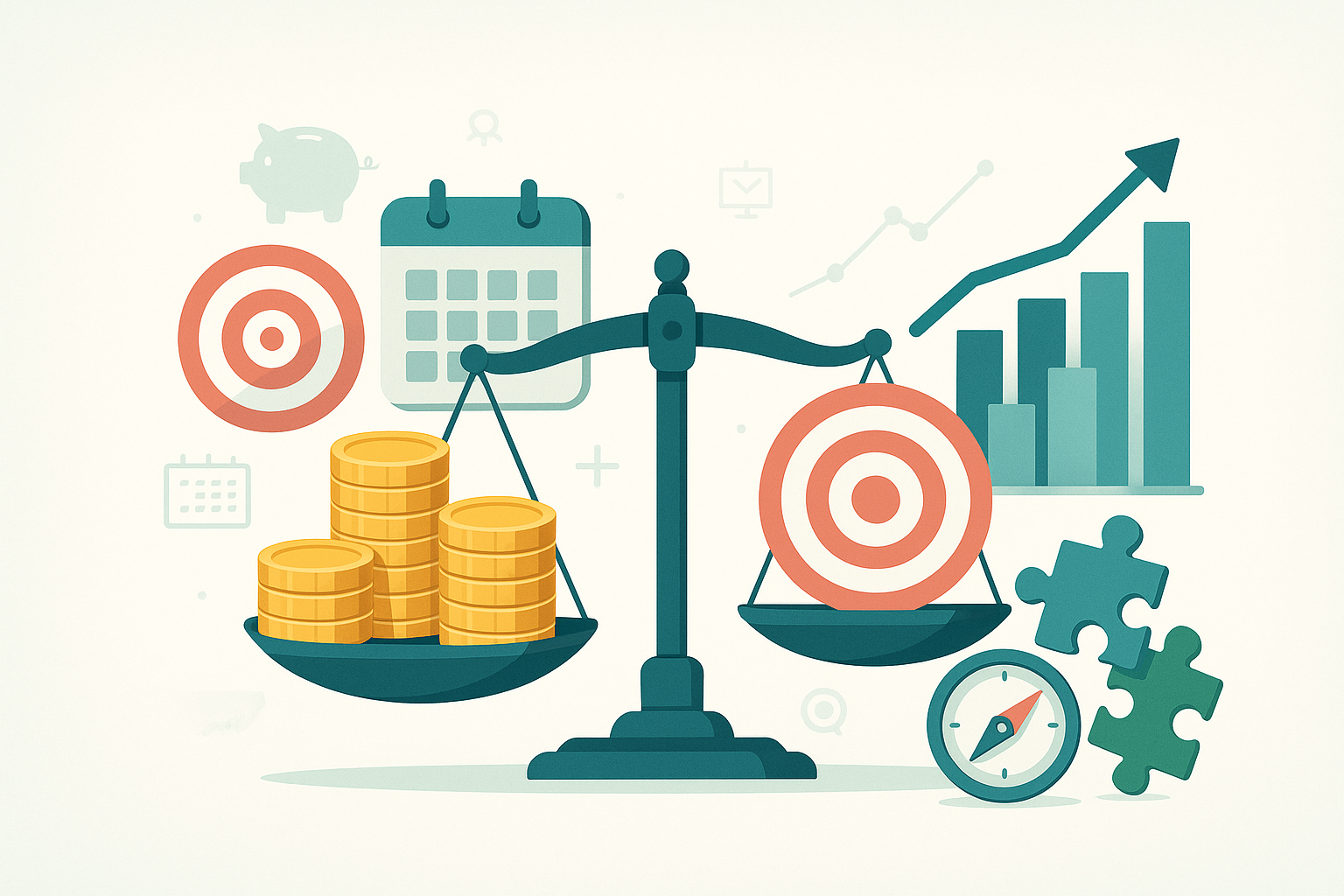

In the journey toward seeking financial security and achieving long-term wealth, individuals constantly face a pivotal question: Should I focus my financial efforts on saving or investing first? This inquiry is not merely a matter of personal preference; it is the cornerstone that determines the strength and durability of your financial foundation. In this comprehensive and expanded article, we will analyze the fundamental difference between these two concepts and map out a clear roadmap for beginners regarding the correct priority for building a financial base, emphasizing that saving is the indispensable preliminary step required to launch into the world of investing.

Part One: Understanding the Tools – Saving vs. Investing
To determine the priority, one must first understand the nature of each of the two primary concepts:
1. The Concept of Saving: Security and Liquidity (Short-term)
Saving is the portion of your income that you do not spend but rather set aside in a safe, highly liquid place (such as bank savings accounts or short-term certificates).
| Feature | Description |
| Primary Goal | Preserving capital and ensuring high security and liquidity. |
| Time Frame | Short to medium term (3 months to 3 years). |
| Return | Very low, often lower than the inflation rate. |
| Risks | Very low (almost non-existent). |
| Ideal Use | Building an emergency fund, saving for a car down payment, or a planned vacation. |
Point of Focus: Saving is your protective shield; it guards your assets against sudden shocks and ensures peace of mind.
2. The Concept of Investing: Growth and Risk (Long-term)
Investing is the employment of saved funds into assets aimed at growing them and increasing their value over time (such as stocks, bonds, real estate, or index funds).
| Feature | Description |
| Primary Goal | Capital growth and wealth multiplication to outpace inflation. |
| Time Frame | Long term (more than 5 to 10 years). |
| Return | High (may reach 7-10% annually or more depending on the asset). |
| Risks | Varying to high; requires enduring market volatility. |
| Ideal Use | Retirement, funding children’s education, achieving financial independence. |
Point of Focus: Investing is the engine of wealth building, utilizing the power of compound interest to increase your money.
Part Two: The Financial Roadmap – Why Should You Start with Saving?
Most financial experts agree that the process of financial building must follow a tiered pyramid, where saving represents the solid base. You cannot build the walls of a house (investments) before laying the foundation (savings).
Phase Zero: Clearing High-Interest Debt (Financial Liberation)
Before any saving or investing, one must decisively deal with high-interest debt (such as credit card debt or personal loans with interest rates exceeding 10%).
-
The Logic: No safe investment will generate a return that exceeds the cost of your high-interest debt. Paying off these debts is the first and best “investment” with a guaranteed return.
Phase One: Building an Emergency Fund (Saving First)
This is the most important goal of the initial saving process. An emergency fund is the safety net that prevents you from resorting to new debt or selling your investments at a loss when an emergency occurs.
How to build an emergency fund?
-
The Goal: Save an amount that covers your basic expenses for 3 to 6 months (rent, food, bills). Sometimes, freelancers or those with unstable incomes prefer to save enough to cover 9 to 12 months.
-
The Location: This amount must be kept in a safe and highly liquid place (an easily accessible savings account).
-
The Priority: The emergency fund ranks second after paying off debt and before actually starting to invest.
Why does saving come first?
-
Securing Investment Capital: Imagine you invested everything you have, and suddenly your car breaks down or you lose your job. You will be forced to withdraw your money from the investment at an inappropriate time, which may lead to a significant loss, in addition to sacrificing the power of compound interest.
-
Peace of Mind: Saving provides a sense of security that makes you better able to take investment risks in later stages.
Phase Two: Investing for Long-Term Goals (Wealth Growth)
Once the emergency fund is complete and high-interest debts are paid off, you have reached the stage of financial maturity that qualifies you to start investing. Here, your surplus monthly income shifts from mere saving to wealth-generating investment.
When should you start investing?
-
After Building the Base: When you are certain that any emergency will not require you to touch your investment funds.
-
For Distant Goals: Investing is inherently designated for goals that need 5 years or more (retirement, buying a home, children’s education). The longer the period, the greater the investment’s ability to grow and the greater your ability to absorb short-term market fluctuations.
Integrating the Two Concepts:
At this stage, saving does not stop; it continues in parallel with investing. You may allocate a portion of your savings for medium-term goals (such as buying new furniture after two years), while the largest portion of the surplus goes toward long-term investment.

See also
Part Three: The Psychological and Planning Aspects of Priority
The decision to start with saving also has psychological and planning dimensions necessary for financial success:
1. Training Financial Discipline
Regular saving (allocating a fixed percentage of income monthly) is practical training for financial discipline. A person who lacks discipline in saving cannot be a successful investor, as both require commitment and a temporary sacrifice of consumption.
-
The 50/30/20 Rule: Many experts recommend allocating 20% of income to saving and investing. Start by allocating this 20% to saving first, then transition it to investing later.
2. Fighting Inflation and Value Erosion
Although safe saving provides high liquidity, its low returns make it vulnerable to erosion by inflation.
| Action | Financial Impact |
| Saving | Preserves the nominal value (the same amount), but purchasing power decreases due to inflation. |
| Investing | Aims to increase the nominal value at a rate exceeding inflation to preserve and increase purchasing power. |
The Result: After building the emergency fund, surplus funds should be immediately diverted to investment as the primary engine for preserving wealth value and growth.
3. Building a Balanced Investment Plan
People who start investing directly without saving for emergencies tend to:
-
Make emotional decisions: They sell their investments at a loss at the first sign of market volatility for fear of needing the money.
-
Take inappropriate risks: They resort to high-risk investments in hopes of compensating for a lack of liquidity quickly.
A conscious investor is one who possesses a secure cash base (emergency savings) that enables them to let their investments grow over the long term without fear.
Conclusion and Final Recommendation: The Integrated Financial Pyramid
The conclusion is that saving and investing are not alternatives to one another; rather, they are two integrated and sequential stages in wealth building.
| Phase | Priority | Financial Action | Time Goal |
| The Base | Debt Repayment | Getting rid of high-interest debt (credit cards and personal loans). | Immediate / Short-term |
| The Foundation | Saving (First) | Creating an emergency fund (3-6 months of expenses). | Short-term (6-12 months) |
| Growth | Investing (Second) | Employing surplus income in diversified investment assets. | Long-term (5 years and above) |
Final Recommendation:
Start by saving until you reach the required emergency fund ceiling, then make automatic saving a permanent part of your budget. However, direct the largest portion of this monthly saving into smart investment channels. This is because saving grants you security in the present, while investing ensures you wealth and financial freedom in the future.