
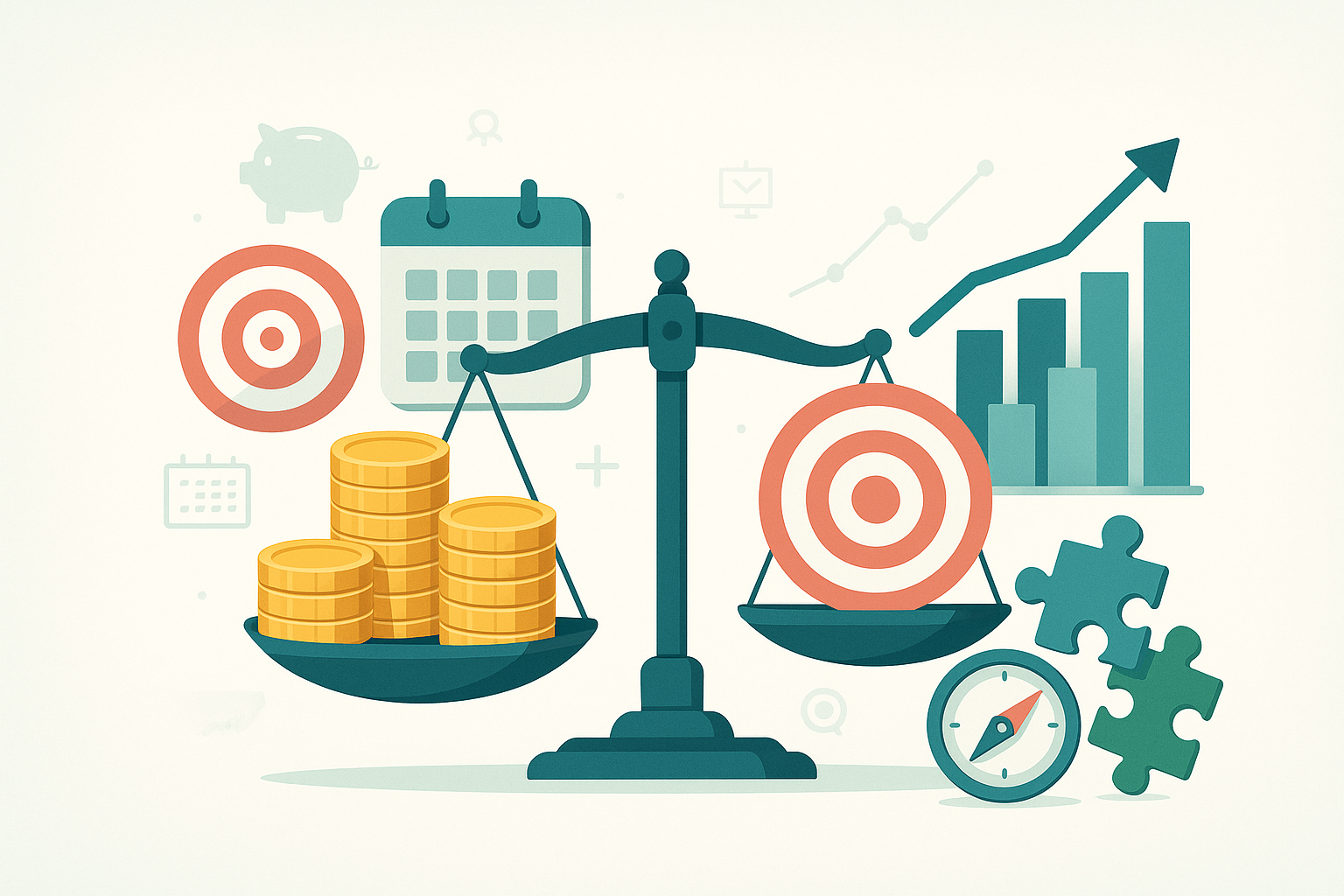


Are you ready to enter the world of investing and build your financial future? Creating a well-thought-out investment plan is your first and most important step. It is not just about buying stocks or assets; it is about creating a clear roadmap that guides your decisions and helps you stay on track, especially during market fluctuations.

1. Define Your Financial Goals (Destination First)
The first step in building a successful investment plan is answering the question: Why are you investing? Your goals should be SMART: Specific, Measurable, Achievable, Relevant, and Time-bound.
-
Short-term Goals (1-3 years): This might be buying a car or saving for a home down payment. Here, low-risk assets with high liquidity are preferred.
-
Medium-term Goals (3-10 years): Such as funding a child’s education or moving to a larger home. Moderate risk can be tolerated during this period.
-
Long-term Goals (10 years or more): Most importantly, retirement. Here, you have plenty of time to ride out market volatility, allowing you to take higher risks for potentially greater returns.
Key takeaway: A clear investment plan must reflect the timeframe for each goal and the amount of money needed to achieve it.
2. Assess Your Financial Situation and Risk Tolerance
Before allocating funds, you must be financially prepared.
A. Settle High-Interest Debts
Do not start an investment plan if you have credit card debt or personal loans with high interest rates. Often, the “return” on paying off these debts is higher than any investment return you can safely achieve.
B. Build an Emergency Fund
An emergency fund should contain 3 to 6 months of living expenses and be placed in highly liquid savings accounts. This fund prevents you from selling your investments at a loss in case of an emergency, keeping your investment plan on track.
C. Determine Your Risk Profile
Your willingness and ability to endure market fluctuations and potential losses determine your portfolio. Factors that define your risk profile are:
-
Age: The younger you are, the more your investment plan can lean toward risk.
-
Income and Stability: A high and stable income allows for greater risk-taking.
-
Personality: Will you panic and sell everything once you see your portfolio drop by 10%? If yes, your plan should be conservative.
See also
3. Asset Allocation (The Building Block of the Plan)
Asset allocation is the distribution of your money among major investment categories. This is the most important practical step in creating an investment plan. Asset allocation determines 90% of your final return.
| Asset Class | Description and Importance in the Plan |
| Stocks (Equities) | Represents partial ownership in a company. Potential return is high, but risk is high. Ideal for long-term goals (retirement). |
| Bonds (Fixed Income) | Represents lending money to a government or corporation. Provides steady income and lower risk. Ideal for the conservative part of the plan and medium-term goals. |
| Cash Equivalents | Includes savings accounts and money market instruments. Provides liquidity and safety, but returns are low. Ideal for emergency funds and short-term goals. |
| Alternative Assets | Such as real estate, commodities (Gold), or cryptocurrencies. Used for diversification against stock and bond volatility. |
Example of Asset Allocation based on risk:
-
Aggressive Investment Plan (Young adult): 80% Stocks, 20% Bonds and Cash.
-
Balanced Investment Plan (Middle-aged): 60% Stocks, 30% Bonds, 10% Cash.
-
Conservative Investment Plan (Near retirement): 30% Stocks, 60% Bonds, 10% Cash.
4. Choosing Specific Investment Vehicles
After determining the allocation percentage, you must choose the instruments to execute the investment plan.
A. Exchange-Traded Funds (ETFs) and Mutual Funds
These are the preferred tools for beginners. Instead of trying to pick a winning stock, index funds allow you to invest in a basket of hundreds of companies (like the S&P 500) at a low cost. This achieves instant diversification, which is a pillar of a wise investment plan.
B. Individual Stocks
These should make up a very small percentage of a beginner’s investment plan (if any). These stocks require deep research, constant monitoring, and increase overall risk.
C. Real Estate
You can invest directly (buying property) or indirectly via Real Estate Investment Trusts (REITs), which are more liquid and suitable for beginners.
5. Regular Investing and Rebalancing
Commitment and consistency are the keys to success for any investment plan.
A. Dollar-Cost Averaging (DCA)
This strategy consists of investing a fixed amount of money regularly, regardless of market prices. This removes the element of emotion and guesswork, ensuring you buy more units when prices are low, which reduces the average purchase cost over the long term. This approach should be an integral part of a beginner’s investment plan.
B. Rebalancing
Over time, asset values change. Stock performance might rise significantly, making them a larger percentage of the plan than intended. You must rebalance periodically (e.g., annually) to sell what has increased and buy what has decreased, returning to the original asset allocation (e.g., 60% stocks / 40% bonds). This maintains the planned risk level.
6. Review and Adjustment (Flexibility)
Creating an investment plan is not a one-time event. You should review it at least once a year or when a major life change occurs.
-
Life Changes: Marriage, having a child, changing jobs, or receiving an inheritance. All these events require an adjustment in goals or risk tolerance.
-
Goal Changes: If a short-term goal is achieved, the money should be reallocated toward the next goal.
Remember: Markets change, but the principles upon which the core investment plan was built (goals, risk tolerance, diversification) should remain steady.
Conclusion: The Essence of a Successful Investment Plan
A successful investment plan does not mean picking the best stocks; it means establishing a logical and rational framework that minimizes emotional decisions. Focus on diversification, lowering costs, and regular long-term investing. Start now, even with a small amount, and keep learning.