



What is positive cash flow and why is it important? How do we achieve it? Is there a way to eliminate negative cash flow? Join us in this article, where we aim to teach you how to achieve positive cash flow and explain all related points. Stay with us until the end of this financial training and utilize the valuable materials we provide.
Understanding cash flow is a fundamental principle of personal and even organizational financial management. An individual’s or a company’s cash flow is a clear indicator of financial health:
-
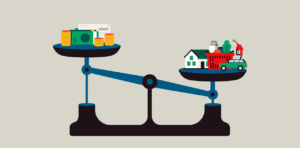
Positive Cash Flow means that income is greater than expenses, and things are going relatively well.
-
Negative Cash Flow, conversely, means that expenses exceed income and must be addressed.
In an organization, negative cash flow signifies that the company is in a poor position. Solutions to cut costs and increase revenue must be implemented as quickly as possible, and new decisions must be made accordingly. Failure to do so could soon lead to the bankruptcy of that institution or company.
Generally, cash flow management depends on two things:
-
Awareness
-
Practice and Persistence
If we are not precise in managing cash flow, we will likely only notice problems when the flow becomes extremely negative. Positive cash flow offers numerous benefits, including:
-
Covering all your basic daily expenses.
-
The opportunity to save and invest.
-
Experiencing less anxiety and stress.
In today’s world, the importance of cash flow management is no longer a secret, which is why we have dedicated an educational article to this topic to help increase your financial awareness.
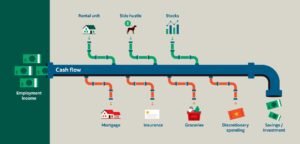
What is Positive Cash Flow? Simply Put
In short, positive cash flow means the money coming into your account is greater than the money going out. Conversely, negative cash flow occurs when expenses exceed income, which can eventually lead to debt, stress, and serious financial problems.
This issue is not limited to personal finance; it is also vital for the financial management of organizations and companies. If a company’s cash flow is negative despite high revenues and acceptable profits, it will be unable to cover operating costs, employee salaries, or debt repayments, facing a financial crisis even with “on-paper” profits.
Therefore, controlling and improving cash flow is one of the most important principles of management for both businesses and individuals. It enables managers and owners to make strategic decisions, identify growth opportunities, and avoid bankruptcy.
Why is it Important to Create Positive Cash Flow?
Creating positive cash flow is vital for several reasons:
-
Financial Security: From a security perspective, it enables an individual or family to manage their affairs without financial worry even when facing unexpected expenses, such as necessary repairs, illness, or a sudden drop in income. Furthermore, it is an essential tool for investment; surplus funds can be put into the stock market, housing, or innovative projects to achieve long-term returns.
-
Avoiding Unnecessary Debt: Positive cash flow prevents the accumulation of unnecessary debt. People who constantly spend more than they earn are forced to take high-interest short-term loans or rely on credit cards, which increases financial pressure. Proper management provides a foundation for financial health and peace of mind.
-
Financial Control: Ultimately, positive cash flow is a tool for financial self-discipline. When individuals or companies know they always have a certain amount of income remaining after expenses, they can make decisions with greater confidence and avoid emotional or hasty choices during stressful times. This is fundamental for building sustainable wealth over time.
Below, we provide strategies to achieve positive cash flow. If you are a financial manager for a company or business, these strategies may also be useful to you.
Strategies for Creating Positive Cash Flow
There are many ways to achieve positive cash flow. In this section, we discuss some of the most important methods, focusing on both controlling outputs and increasing financial inputs.
1. Increase Income
Increasing your income is naturally one of the most effective ways to achieve positive cash flow. This can be done through a second job, freelancing, or investing in high-yield areas. Improving your skills also increases your value in the labor market. This doesn’t always mean a second job; you can increase your income through specialized training in your current field. Additionally, skilled individuals (in content creation, graphic design, etc.) can take on projects via freelance websites with no time or location restrictions. Beyond active income, you can earn passive income—money earned with little to no daily effort, such as through investments, selling online courses, or crowdfunding programs.
2. Reduce Unnecessary Costs
The second key step is controlling expenses. Without this, even an increase in income won’t change your situation much. A quick way to identify unnecessary expenses is the “Two-Week Rule”: delay a non-essential purchase for two weeks. If you still need it and its absence affects your life, buy it. Many expenses are based on emotions rather than needs. Reducing restaurant visits, impulsive purchases, or unnecessary subscriptions will balance your monthly budget.
3. Budgeting and Prioritizing Spending
You must learn the skill of budgeting. Tracking every income and expense provides an accurate picture of your financial flow. Using methods like the 50/30/20 rule or Zero-Based Budgeting helps balance needs, wants, and savings. Analyzing your budget monthly allows you to identify and correct deviations quickly.
4. Establish an Emergency Fund
An emergency fund acts as a buffer for unexpected costs like medical bills or car repairs. With this fund, you won’t need to rely on credit cards or high-interest debt, directly contributing to your positive cash flow. It is recommended to keep 3 to 6 months of living expenses in this fund, using it only for true emergencies.
5. Use Financial Management Tools and Apps
Digital tools facilitate cash flow management by automatically recording transactions, categorizing expenses, and providing analytical charts. These tools help you quickly identify financial weaknesses and optimize your savings.
6. Invest Smartly
Smart investing is a powerful way to boost cash flow, especially when it generates passive income. Investing in stocks, mutual funds, or fixed-income securities can provide steady returns. Long-term investment also protects you from inflation. While this requires financial knowledge and risk management, it ensures a sustainable positive flow over time.
See also
Common Mistakes in Cash Flow Management
To succeed, we must identify and avoid common pitfalls:
-
A. Spending More Than You Earn: This is the most destructive mistake. Overspending on non-essentials leads to a direct cash deficit, forcing a reliance on debt and creating a negative cycle.
-
B. Ignoring Small Expenses: Small daily costs (coffee, snacks, minor subscriptions) can add up to a significant portion of your income. Over time, these small leaks are often the difference between a positive and negative cash flow.
-
C. Lack of Budgeting and Financial Planning: Without a plan, decisions are made impulsively. Many people only realize there is a problem once debt has accumulated. A detailed monthly budget is essential to stay in control and avoid emotional financial decisions.

Final Conclusion and Summary
Achieving and maintaining positive cash flow is one of the most vital principles of successful financial management in both personal and professional life. Positive cash flow is achieved when income exceeds expenses and resources are managed efficiently.
The path includes increasing income, cutting unnecessary costs, strict budgeting, building an emergency fund, and using digital tools. We also highlighted that smart investments and passive income play a major role in long-term stability.
Remember, achieving positive cash flow is a gradual process; change does not happen overnight. It requires patience and commitment. Even small steps, like recording daily expenses or setting a limit on entertainment spending, can lead to significant improvements over time. Positive cash flow provides the foundation for saving, investing, and growing your wealth.
We suggest you take the first practical steps today by accurately recording your expenses and reviewing your priorities to pave your way toward financial stability.
FAQ
What is positive cash flow? Positive cash flow occurs when total income exceeds total expenses, leaving you with extra money to save or invest.
Is it possible to create positive cash flow with a low income? Yes. Through cost control, precise budgeting, and smart expense management, you can achieve positive cash flow even with a modest income.
What is the best way to improve cash flow? Reducing unnecessary expenses, increasing income, and adhering to a regular budget are the most effective methods.
What is the difference between cash flow and net profit? Net profit is revenue minus expenses (often on paper), but cash flow represents the actual physical cash available for daily use and obligations.